Algorithm Engineering — T03
Linear Expressions
\[ \begin{aligned} \max\quad & \sum_{e \in \delta^+(s)} x_e \\ \text{s.t.}\quad & \sum_{e \in \delta^+(v)} x_e = \sum_{e \in \delta^-(v)} x_e & \forall v \in V \\ & 0 \le x_e \le u_e & \forall e \in E \end{aligned} \]
\[ \begin{aligned} \max\quad & \sum_i v_i\, b_i \\ \text{s.t.}\quad & \sum_i w_i\, b_i \le W \\ & b_i \in \{0, 1\} && \forall i \end{aligned} \]
Continuous Variables (Linear Programs)
Solvable in polynomial time.
Discrete Variables (Mixed-Integer Programs)
NP-hard in general but often tractable.
For both problem classes, there are highly engineered solvers. How much can we express in each class? How do we know if it is the right technology?
\[ \begin{aligned} \min\quad & \sum_j c_j\, x_j \\ \text{s.t.}\quad & \sum_j a_{ij}\, x_j \;\ge\; b_i & \forall i \\ & x_j \ge 0 \end{aligned} \]
Choose food quantities \(x_j\) to meet every nutrient requirement \(b_i\) at minimum cost. Coefficient \(a_{ij}\) = nutrient \(i\) per unit of food \(j\).
| Food \(j\) | kcal | protein (g) | calcium (mg) | \(c_j\) (€/unit) |
|---|---|---|---|---|
| Oats | 380 | 13 | 50 | 0.20 |
| Milk | 150 | 8 | 300 | 0.80 |
| Eggs | 80 | 7 | 30 | 0.30 |
| Beans | 230 | 15 | 80 | 0.40 |
| Daily req. \(b_i\) | 2000 | 50 | 800 |
Real-world siblings:
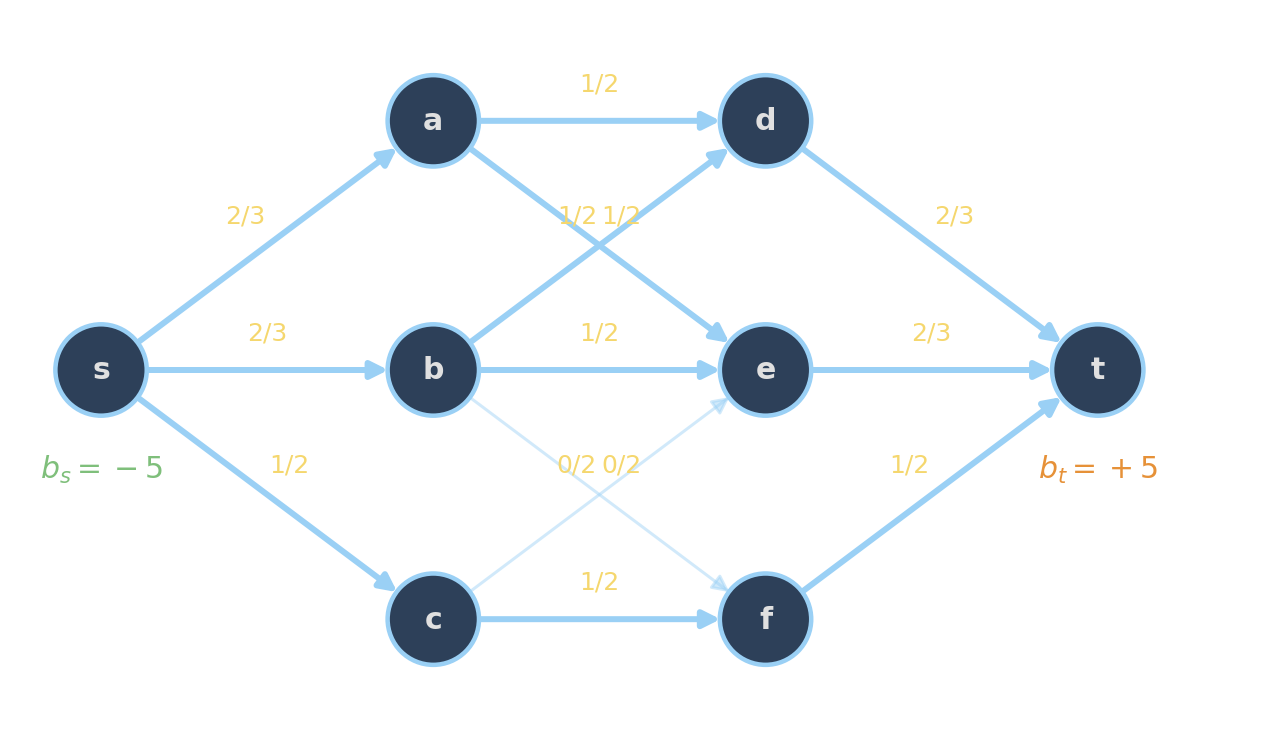
\[ \min\quad \sum_{e \in E} c_e\, x_e \] \[ \sum_{e \in \delta^-(v)} x_e - \sum_{e \in \delta^+(v)} x_e = b_v\quad \forall v \in V \\ 0 \le x_e \le u_e \quad \forall e \in E \]
Real-world siblings:
Special cases: shortest path, max-flow, transportation, assignment.
Edge labels: flow \(x_e\) / capacity \(u_e\). \(b_v < 0\) supplies, \(b_v > 0\) demands.
\[ \begin{aligned} \max\quad & \sum_{e \in E} c_e\, x_e \\ \text{s.t.}\quad & \sum_{e \in \delta(v)} x_e \;\le\; 1 && \forall v \in V \\ & x_e \in \{0,1\} \end{aligned} \]
Pick edges of an undirected graph to maximize total weight, no two chosen edges sharing a vertex. A vertex may stay unmatched.
Real-world siblings:
The basic version is polynomial, but as soon as there are interdependencies between edges or we have t-wise instead of pairwise matchings, the Blossom algorithm fails and we need MIP.
\[ \begin{aligned} \min\quad & \sum_{S \in \mathcal{S}} c_S\, y_S \\ \text{s.t.}\quad & \sum_{S \ni i} y_S \;\ge\; 1 && \forall\ i\\ & y_S \in \{0,1\} \end{aligned} \]
Pick subsets \(S\) so every element \(i\) is covered at least once, at minimum cost.
Real-world siblings:
Surprisingly many difficult combinatorial optimization problems turn out to be variants of Set Cover (\(\geq 1\)), Set Packing (\(\leq 1\)), or Set Partitioning (\(=1\)) at heart.
| # | Expression | \(\mathrel{\hat{=}}\text{LP}\) | \(\mathrel{\hat{=}}\text{MIP}\) | approx. only |
|---|---|---|---|---|
| 1 | \(\min\ \max_i\, c_i^\top x_i, x\in \mathbb{R}^n\) | ✓ | ||
| 2 | \(\max\ \sum_i \lvert x_i \rvert, x\in \mathbb{R}^n\) | ✓ | ||
| 3 | \(\min\ \sum_i \lvert x_i \rvert, x\in \mathbb{R}^n\) | ✓ | ||
| 4 | \(\min\ \sum_i x_i^2, x\in \mathbb{R}^n\) | ✓ | ||
| 5 | \(c^\top x \ge a\ \ \lor\ \ c'^\top x \le a', x\in \mathbb{R}^n\) | ✓ | ||
| 6 | \(z = x\,y,\ x \in \{0,1\},\ y \in [L, U]\) | ✓ | ||
| 7 | \(z = x\,y,\ x, y \in [L, U]\) | ✓ |
Things are not always as they seem. Which of these non-linear expressions are actually linear in disguise?
“Every hard problem has a weakness. The modeler’s art is to find it before the solver finds despair.”
— Confucypus
Once you know the basics, you can essentially use any LP/MIP solver you like.
Solver-agnostic layers
Build once, swap backends.
Vendor SDKs
Tied to one solver; richest access to vendor-specific features.
We will use MathOpt — free, Pythonic, and dispatches to GLOP, HiGHS, SCIP, CP-SAT, Gurobi, … with a single argument. The patterns in this lecture transfer to any of the others.
Build the model
from ortools.math_opt.python import mathopt as mo
model = mo.Model(name="...")
# --- Variables ---
x = model.add_variable(lb=0, name="x")
y = [model.add_variable(lb=0, ub=100, is_integer=True)
for i in range(10)]
b = model.add_binary_variable(name="b")
# --- Expressions ---
expr = 3 * x + 2 * n - b
total = sum(c[e] * y[e] for e in items)
# --- Constraints ---
model.add_linear_constraint(expr <= 5)
model.add_linear_constraint(x + n == 7)
model.add_linear_constraint(total >= 1)
# --- Objective ---
model.minimize(expr)Solve the model
# --- Solve ---
from datetime import timedelta
params = mo.SolveParameters(
enable_output=True,
time_limit=timedelta(seconds=30),
)
result = mo.solve(model, mo.SolverType.HIGHS,
params=params)
# SolverType.GLOP / .HIGHS / .GSCIP /
# .CP_SAT / .GUROBI / ...
# --- Read back ---
result.termination.reason
result.objective_value()
result.variable_values()[x]MathOpt exposes some backend-specific features. Example: CP-SAT has no continuous variables — pass a continuous model to SolverType.CP_SAT and MathOpt raises before solving.
MathOpt (OR-Tools)
from ortools.math_opt.python import mathopt as mo
model = mo.Model("mincostflow")
x = {e: model.add_variable(lb=0, ub=cap[e])
for e in edges}
model.add_linear_constraint(x["sa"] == x["ab"] + x["at"])
model.add_linear_constraint(x["sb"] + x["ab"] == x["bt"])
model.add_linear_constraint(x["sa"] + x["sb"] >= demand)
model.minimize(sum(cost[e] * x[e] for e in edges))
result = mo.solve(model, mo.SolverType.GUROBI)
# swap to GLOP / HIGHS / GSCIP / CP_SAT
# — model unchangedgurobipy (Gurobi native)
import gurobipy as gp
from gurobipy import GRB
m = gp.Model("mincostflow")
x = m.addVars(edges, lb=0, ub=cap)
m.addConstr(x["sa"] == x["ab"] + x["at"])
m.addConstr(x["sb"] + x["ab"] == x["bt"])
m.addConstr(x["sa"] + x["sb"] >= demand)
m.setObjective(gp.quicksum(cost[e] * x[e] for e in edges),
GRB.MINIMIZE)
m.optimize()
# locked to Gurobi — different vendor = rewriteThe shape is the same. The vocabulary differs. With a solver-agnostic layer the model description outlives the choice of solver; with a vendor SDK the two are coupled.
Some things get linear by just adding some variables.
\[ \begin{aligned} \min\quad & \max_i\ f_i(x) \\ \text{s.t.}\quad & \dots \end{aligned} \]
\(\Longrightarrow\)
\[ \begin{aligned} \min\quad & z \\ \text{s.t.}\quad & f_i(x) \le z && \forall i \\ & \dots \end{aligned} \]
\[ \begin{aligned} \max\quad & \min_i\ f_i(x) \\ \text{s.t.}\quad & \dots \end{aligned} \]
\(\Longrightarrow\)
\[ \begin{aligned} \max\quad & z \\ \text{s.t.}\quad & z \le f_i(x) && \forall i \\ & \dots \end{aligned} \]
This creates extra variables/constraints, but the complexity of an LP is not measured by the number of variables or constraints. Don’t worry too much about the number of constraints and variables, but about the length of the expressions.
L1 deviation
from a target \(t\)
\[ \begin{aligned} \min\quad & \sum_i \lvert x_i - t_i \rvert \\ \text{s.t.}\quad & \dots \end{aligned} \]
\(\Longrightarrow\)
\[ \begin{aligned} \min\quad & \sum_i d_i \\ \text{s.t.}\quad & d_i \ge x_i - t_i && \forall i \\ & d_i \ge t_i - x_i && \forall i \\ \end{aligned} \]
L-infinity
deviation
\[ \begin{aligned} \min\quad & \max_i\ \lvert x_i - t_i \rvert \\ \text{s.t.}\quad & \dots \end{aligned} \]
\(\Longrightarrow\)
\[ \begin{aligned} \min\quad & d \\ \text{s.t.}\quad & d \ge x_i - t_i && \forall i \\ & d \ge t_i - x_i && \forall i \\ \end{aligned} \]
The target \(t\) may itself be a decision variable — e.g. the mean \(t = \tfrac{1}{n}\sum_i x_i\) — and the formulation stays LP-friendly.
Given data \((\xi_i, \eta_i)\), fit \(\eta \approx \alpha\,\xi + \beta\) by minimizing \(\sum_i \lvert \eta_i - (\alpha\,\xi_i + \beta) \rvert\).
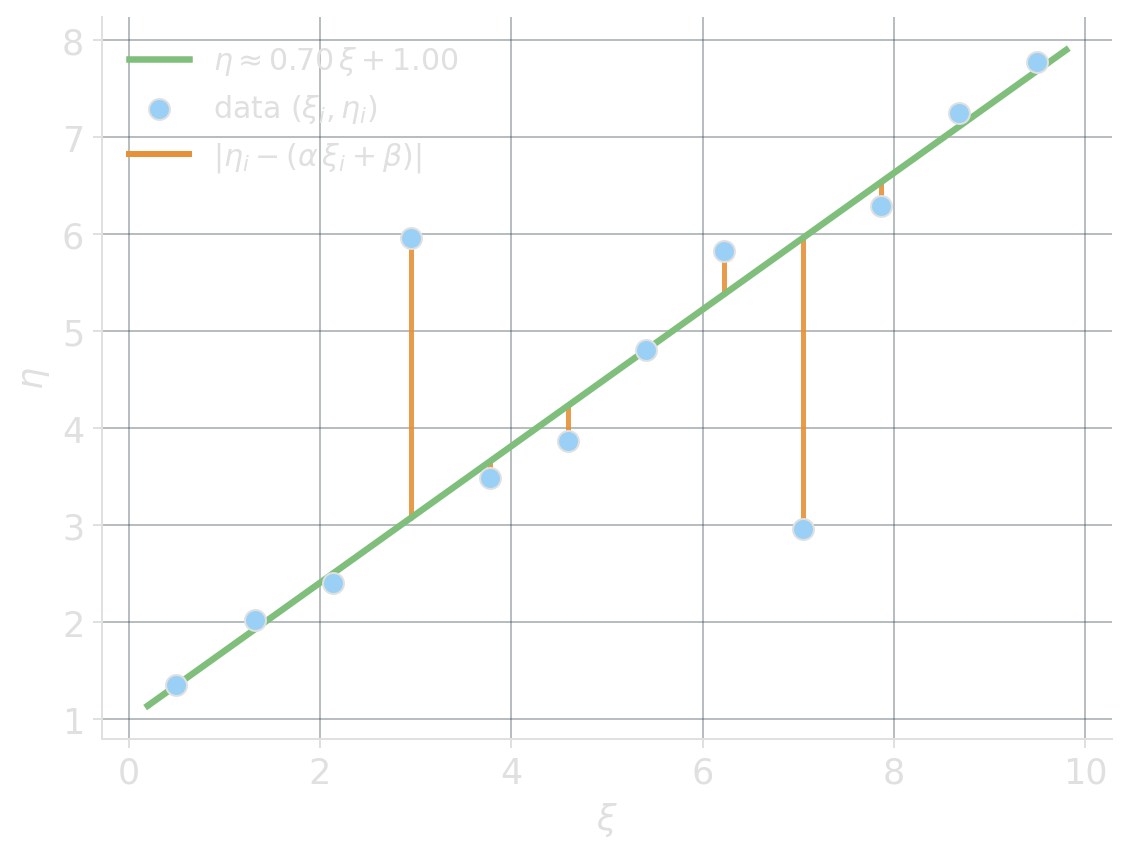
An LP in \(2 + n\) variables: \[ \begin{aligned} \min\quad & \sum_i d_i \\ \text{s.t.}\quad & d_i \ge\ \eta_i - (\alpha\,\xi_i + \beta) && \forall i \\ & d_i \ge\ (\alpha\,\xi_i + \beta) - \eta_i && \forall i \\ & \alpha,\ \beta \in \mathbb{R},\ \ d_i \ge 0. \end{aligned} \]
There are better ways to solve L1 regression than using a general-purpose LP solver.

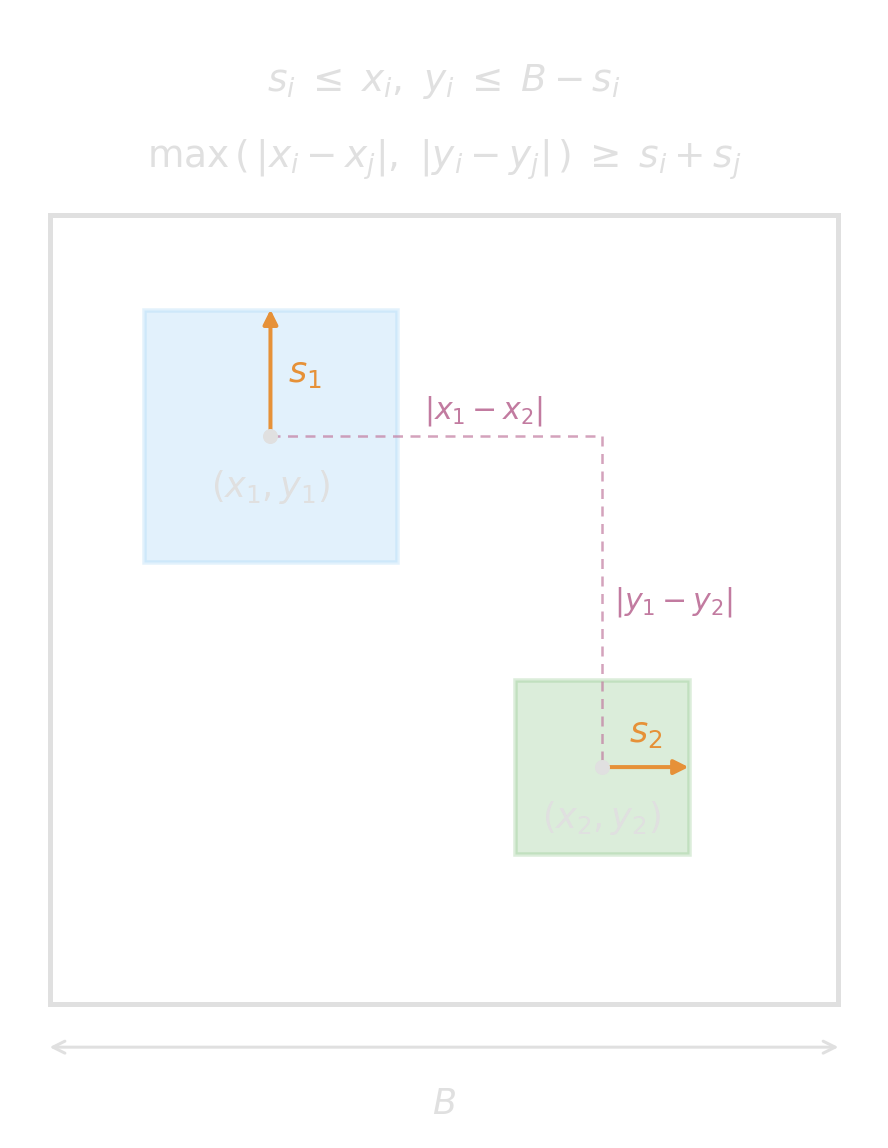
Let us try the trick again: \[ \left. \begin{aligned} d^x_{ij} &\ge x_i - x_j \\ d^x_{ij} &\ge x_j - x_i \end{aligned}\ \right\} \Rightarrow d^x_{ij} \ge \lvert x_i - x_j \rvert \]
Same for the y-axis with \(d^y_{ij}\), and then
\[ \left. \begin{aligned} D_{ij} &\ge d^x_{ij} \\ D_{ij} &\ge d^y_{ij} \end{aligned}\ \right\} \Rightarrow D_{ij} \ge \max(d^x_{ij},\, d^y_{ij}) \]
Will \(D_{ij} \ge s_i + s_j\) guarantee no overlap?
Confucypus says, if your LP solves an NP-hard problem, you probably messed up. Here, we would have needed \(\leq\).
The hammer to make nearly anything linear.
\[ b = 1 \;\Rightarrow\; a^\top x \le c \quad \Longleftrightarrow \quad a^\top x \le c + M\,(1 - b)\quad \text{ with } M\approx \infty \]
| \(b\) | constraint | meaning |
|---|---|---|
| \(1\) | \(a^\top x \le c\) | active |
| \(0\) | \(a^\top x \le c + M\) | relaxed |
We can also encode equality \(a^\top x = c\): \[ \begin{aligned} \quad a^\top x \le c + M\,(1 - b) \\ -a^\top x \le -c + M\,(1 - b) \end{aligned} \]
With this, we can easily model, e.g., \(|x| = d\) by introducing two binaries \(b^+\) and \(b^-\):
\[ \left. \begin{aligned} \phantom{-}x &\le \phantom{-}d + M\,(1 - b^+) \\ -x &\le -d + M\,(1 - b^+) \end{aligned} \right\} \text{if } b^+=1 \text{: enforce } d = x \]
\[ \left. \begin{aligned} -x &\le \phantom{-}d + M\,(1 - b^-) \\ \phantom{-}x &\le -d + M\,(1 - b^-) \end{aligned} \right\} \text{if } b^-=1 \text{: enforce } d = -x \]
\[ b^+ + b^- = 1, \quad d \ge 0. \quad \text{(Exactly one branch active, and $d$ non-negative.)} \]
\(d = \min(x, y)\) with binary \(b\):
\[ d \le x, \quad d \le y \]
\[ \left. \begin{aligned} d &\ge x - M\,(1 - b) \\ d &\ge y - M\,b \end{aligned} \right\} \small\text{select which is smaller} \]
| \(b\) | active | result |
|---|---|---|
| \(1\) | \(d \ge x, d \le x, d \le y\) | \(d = x\) |
| \(0\) | \(d \ge y, d \le x, d \le y\) | \(d = y\) |
\(d = \max(x, y)\) with binary \(b\):
\[ d \ge x, \quad d \ge y \]
\[ \left. \begin{aligned} d &\le x + M\,(1 - b) \\ d &\le y + M\,b \end{aligned} \right\} \small\text{select which is larger} \]
| \(b\) | active | result |
|---|---|---|
| \(1\) | \(d \le x, d\ge x, d\ge y\) | \(d = x\) |
| \(0\) | \(d \le y, d\ge x, d\ge y\) | \(d = y\) |
For n-ary min or max, introduce one binary per candidate and an exactly-one constraint to select the active branch.

\[ \max(|x_i - x_j|, |y_i - y_j|) \ge s_i + s_j \]
can be enforced by \[ \begin{aligned} & x_j - x_i &\ge s_i + s_j - M(1 - b^{R}_{ij}), \\ & x_i - x_j &\ge s_i + s_j - M(1 - b^{L}_{ij}), \\ & y_j - y_i &\ge s_i + s_j - M(1 - b^{A}_{ij}), \\ & y_i - y_j &\ge s_i + s_j - M(1 - b^{B}_{ij}), \end{aligned} \] \[ b^{L}_{ij} + b^{R}_{ij} + b^{A}_{ij} + b^{B}_{ij} = 1. \]
“Need to be separated either from the left, the right, above, or below.”

\[ b^{L}_{ij} = b^{R}_{ij} = b^{A}_{ij} = b^{B}_{ij} = 0.25 \]
\[ \begin{aligned} & x_j - x_i \ge s_i + s_j - M(1 - 0.25), \\ & x_i - x_j \ge s_i + s_j - M(1 - 0.25), \\ & y_j - y_i \ge s_i + s_j - M(1 - 0.25), \\ & y_i - y_j \ge s_i + s_j - M(1 - 0.25), \end{aligned} \]
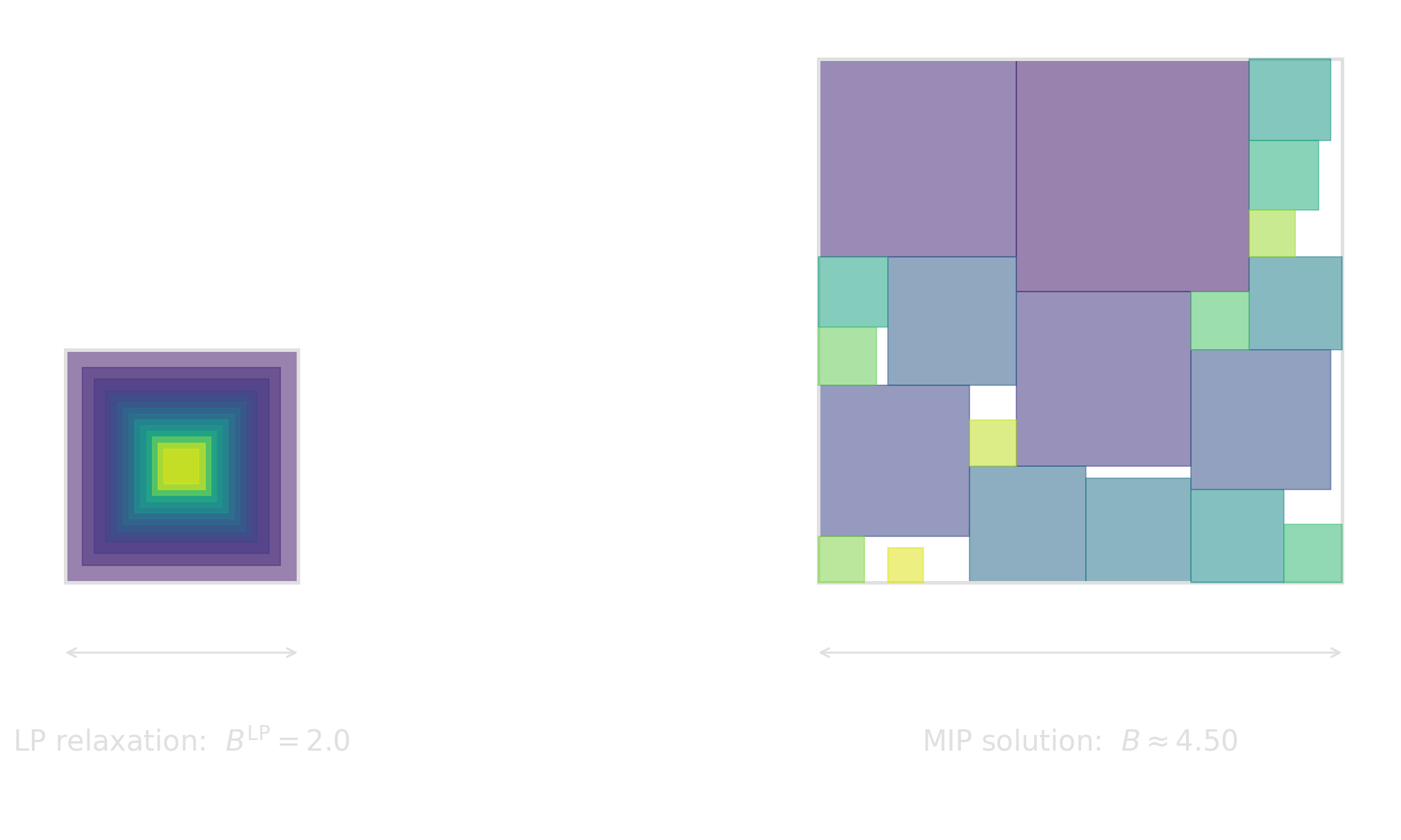
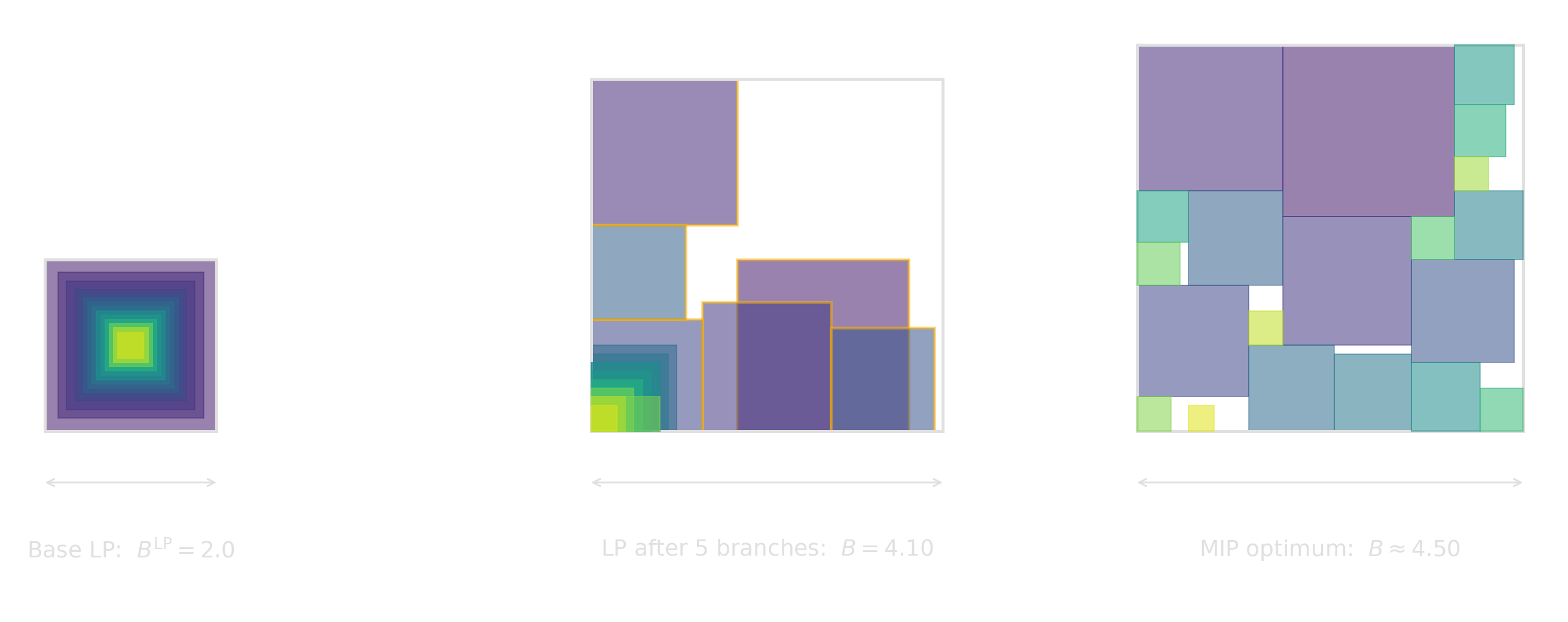
The larger \(M\), the weaker the constraint in the relaxation. In this case, the relaxation is particular weak because even a tight \(M\approx 4\) (why is this tight?) gives too much slack and nearly all constraints are impacted.
Fixing just five \(b^*_{ij}\) binaries among the largest squares lifts the LP bound from \(2.0\) to \(4.10\), closing most of the gap to the MIP optimum \(B^\star \approx 4.50\). Each branch turns one Big-M slack off and forces a real separation.
Big-M controlled by boolean logic allows expressing nearly anything.
Counting
\[ \sum_i b_i \le 1 \quad \text{at most one} \]
\[ \sum_i b_i = 1 \quad \text{exactly one} \]
\[ \sum_i b_i \ge 1 \quad \text{at least one} \]
Implication \(b_1 \Rightarrow b_2 \equiv b_1 \;\le\; b_2\).
| \(b_1\) | \(b_2\) | \(b_1 \Rightarrow b_2\) | \(b_1 \le b_2\) |
|---|---|---|---|
| \(0\) | \(0\) | ✓ | ✓ |
| \(0\) | \(1\) | ✓ | ✓ |
| \(1\) | \(0\) | ✗ | ✗ |
| \(1\) | \(1\) | ✓ | ✓ |
Negation: \(\;\lnot b \;\equiv\; (1 - b).\)
With at least one and negation, we can already enforce any Boolean function on binaries. However, if we want, e.g., to do \((b_1 \vee b_2) \Rightarrow c^\top x \le d\), we need the AND and OR bindings on the next two slides.
\[ z = b_1 \land b_2 \quad\Longleftrightarrow\quad z \le b_1, \;\; z \le b_2, \;\; z \ge b_1 + b_2 - 1. \]
| \(b_1\) | \(b_2\) | \(z\) | \(b_1 \land b_2\) | \(z \le b_1\) | \(z \le b_2\) | \(z \ge b_1+b_2-1\) |
|---|---|---|---|---|---|---|
| 0 | 0 | 0 | \(= 0\) | ✓ | ✓ | ✓ |
| 0 | 0 | 1 | \(\neq 0\) | ✗ | ✗ | ✓ |
| 0 | 1 | 0 | \(= 0\) | ✓ | ✓ | ✓ |
| 0 | 1 | 1 | \(\neq 0\) | ✗ | ✓ | ✓ |
| 1 | 0 | 0 | \(= 0\) | ✓ | ✓ | ✓ |
| 1 | 0 | 1 | \(\neq 0\) | ✓ | ✗ | ✓ |
| 1 | 1 | 0 | \(\neq 1\) | ✓ | ✓ | ✗ |
| 1 | 1 | 1 | \(= 1\) | ✓ | ✓ | ✓ |
General \(n\)-ary form. \(z = \bigwedge_{i=1}^n b_i \;\Longleftrightarrow\; z \le b_i \;\;\forall i, \;\; z \ge \sum_{i=1}^n b_i - (n-1).\)
\[ z = b_1 \lor b_2 \quad\Longleftrightarrow\quad z \ge b_1, \;\; z \ge b_2, \;\; z \le b_1 + b_2. \]
| \(b_1\) | \(b_2\) | \(z\) | \(b_1 \lor b_2\) | \(z \ge b_1\) | \(z \ge b_2\) | \(z \le b_1+b_2\) |
|---|---|---|---|---|---|---|
| 0 | 0 | 0 | \(= 0\) | ✓ | ✓ | ✓ |
| 0 | 0 | 1 | \(\neq 0\) | ✓ | ✓ | ✗ |
| 0 | 1 | 0 | \(\neq 1\) | ✓ | ✗ | ✓ |
| 0 | 1 | 1 | \(= 1\) | ✓ | ✓ | ✓ |
| 1 | 0 | 0 | \(\neq 1\) | ✗ | ✓ | ✓ |
| 1 | 0 | 1 | \(= 1\) | ✓ | ✓ | ✓ |
| 1 | 1 | 0 | \(\neq 1\) | ✗ | ✗ | ✓ |
| 1 | 1 | 1 | \(= 1\) | ✓ | ✓ | ✓ |
General \(n\)-ary form. \(z = \bigvee_{i=1}^n b_i \;\Longleftrightarrow\; z \ge b_i \;\;\forall i, \;\; z \le \sum_{i=1}^n b_i.\)
A binary \(b\) activates a continuous \(x\): either off (zero) or live (in a range).
\(x\) is either \(0\) or lies in \([L, U]\) with \(0 < L \le U\):
\[ x \in \{0\} \cup [L, U] \qquad\Longleftrightarrow\qquad L\, b \le x \le U\, b, \quad b \in \{0, 1\}. \]
| \(b\) | \(L\, b \le x\) | \(x \le U\, b\) | \(x\) |
|---|---|---|---|
| \(0\) | \(0 \le x\) | \(x \le 0\) | \(= 0\) |
| \(1\) | \(L \le x\) | \(x \le U\) | \(\in [L, U]\) |
The same \(b\) doubles as a fixed-charge switch: add \(c\, b\) to the objective and you pay \(c\) whenever \(x \neq 0\).
\(x\) lies in one of several disjoint intervals:
\[ x \in [L_1, U_1] \cup [L_2, U_2] \cup [L_3, U_3]. \]
Reusing one shared \(x\) with three semi-continuous blocks pins \(x\) to zero — every off-block forces \(x = 0\) simultaneously.
Split \(x\) into one continuous part per interval; an exactly-one selector picks the live part:
\[ x = x_1 + x_2 + x_3, \quad L_k\, b_k \le x_k \le U_k\, b_k, \quad b_1 + b_2 + b_3 = 1. \]
| \((b_1, b_2, b_3)\) | \(x_1\) | \(x_2\) | \(x_3\) | \(x = \sum_k x_k\) |
|---|---|---|---|---|
| \((1, 0, 0)\) | \(\in [L_1, U_1]\) | \(= 0\) | \(= 0\) | \(\in [L_1, U_1]\) |
| \((0, 1, 0)\) | \(= 0\) | \(\in [L_2, U_2]\) | \(= 0\) | \(\in [L_2, U_2]\) |
| \((0, 0, 1)\) | \(= 0\) | \(= 0\) | \(\in [L_3, U_3]\) | \(\in [L_3, U_3]\) |
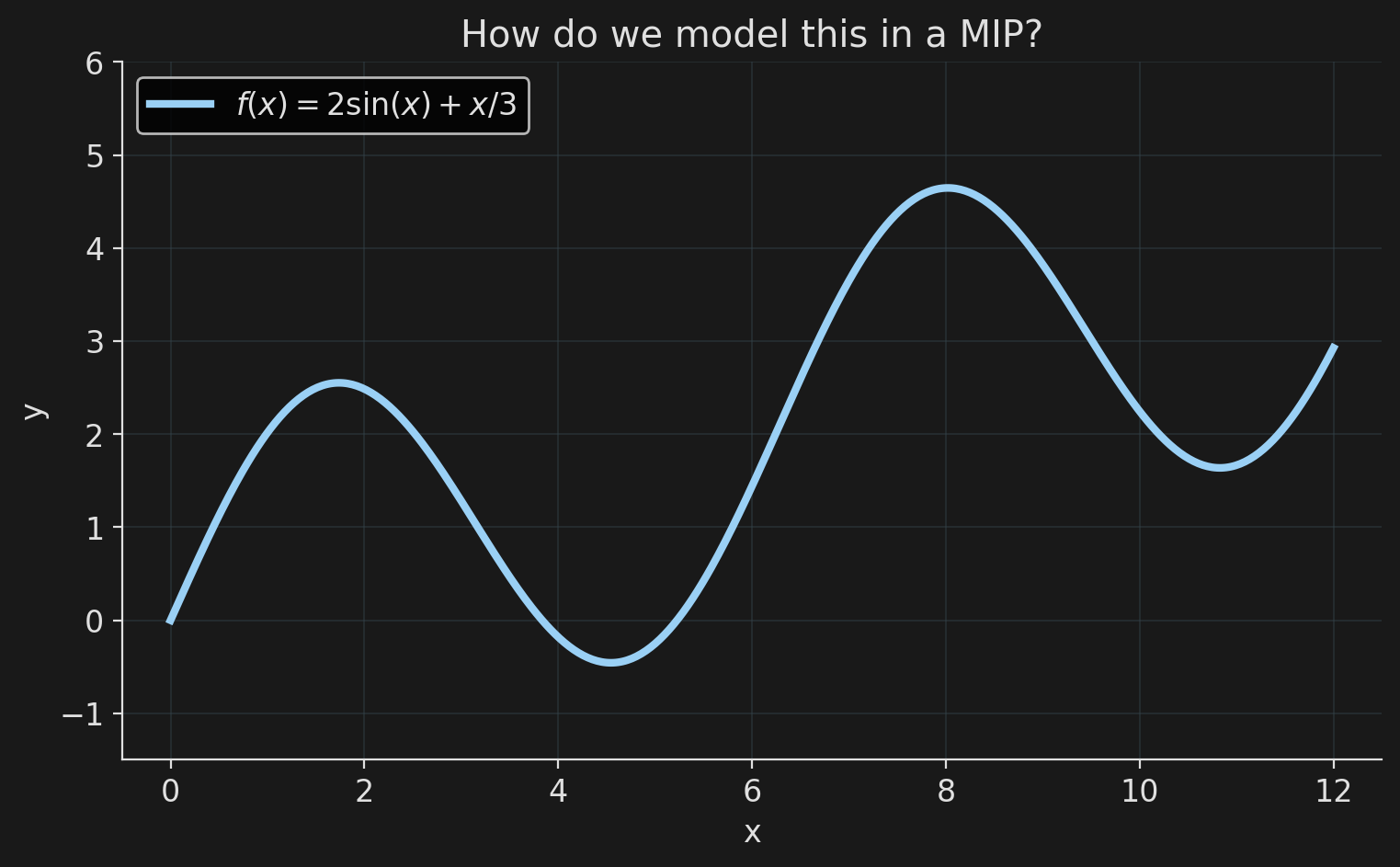
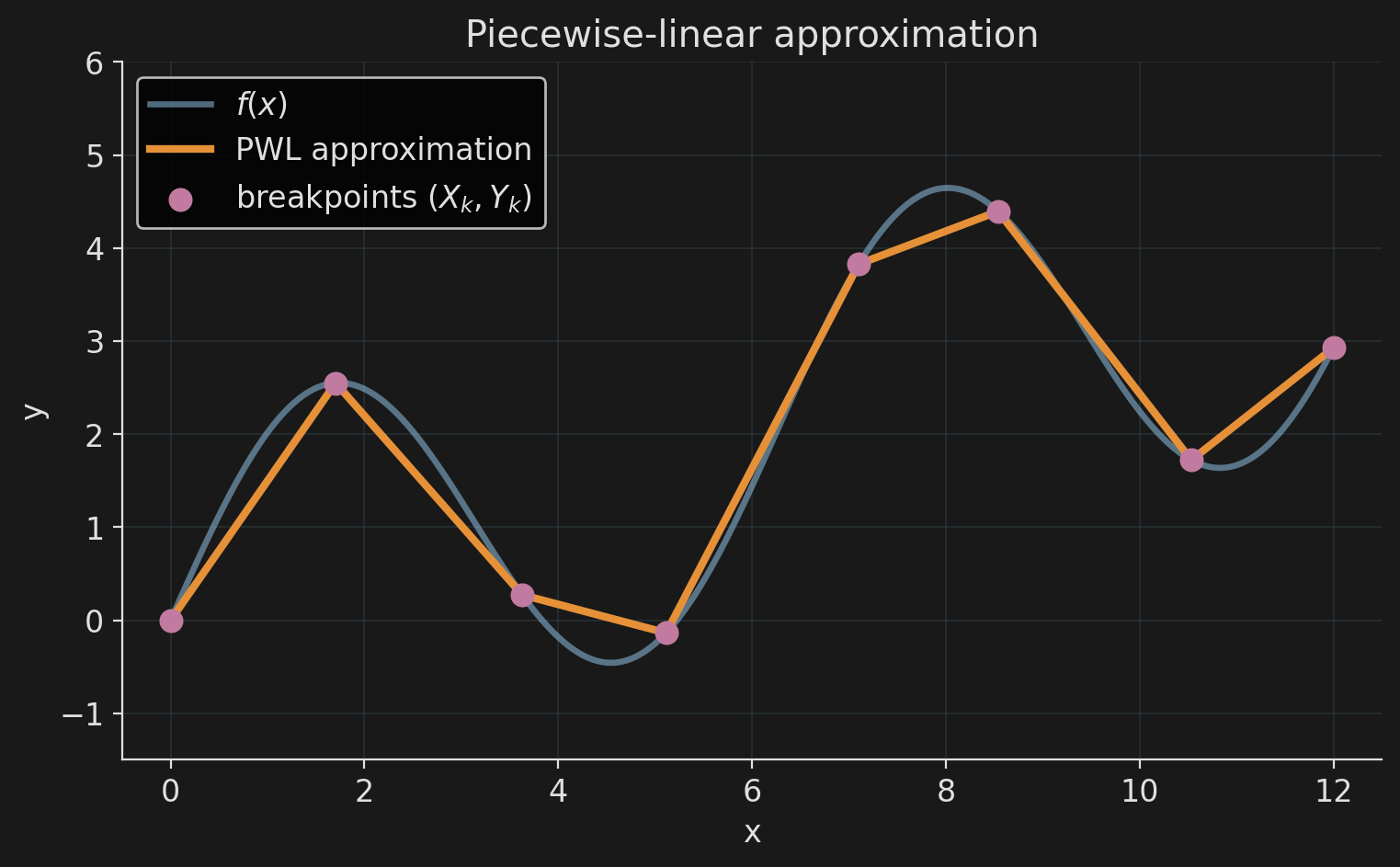
When the function itself is nonlinear, approximate with line segments and commit.


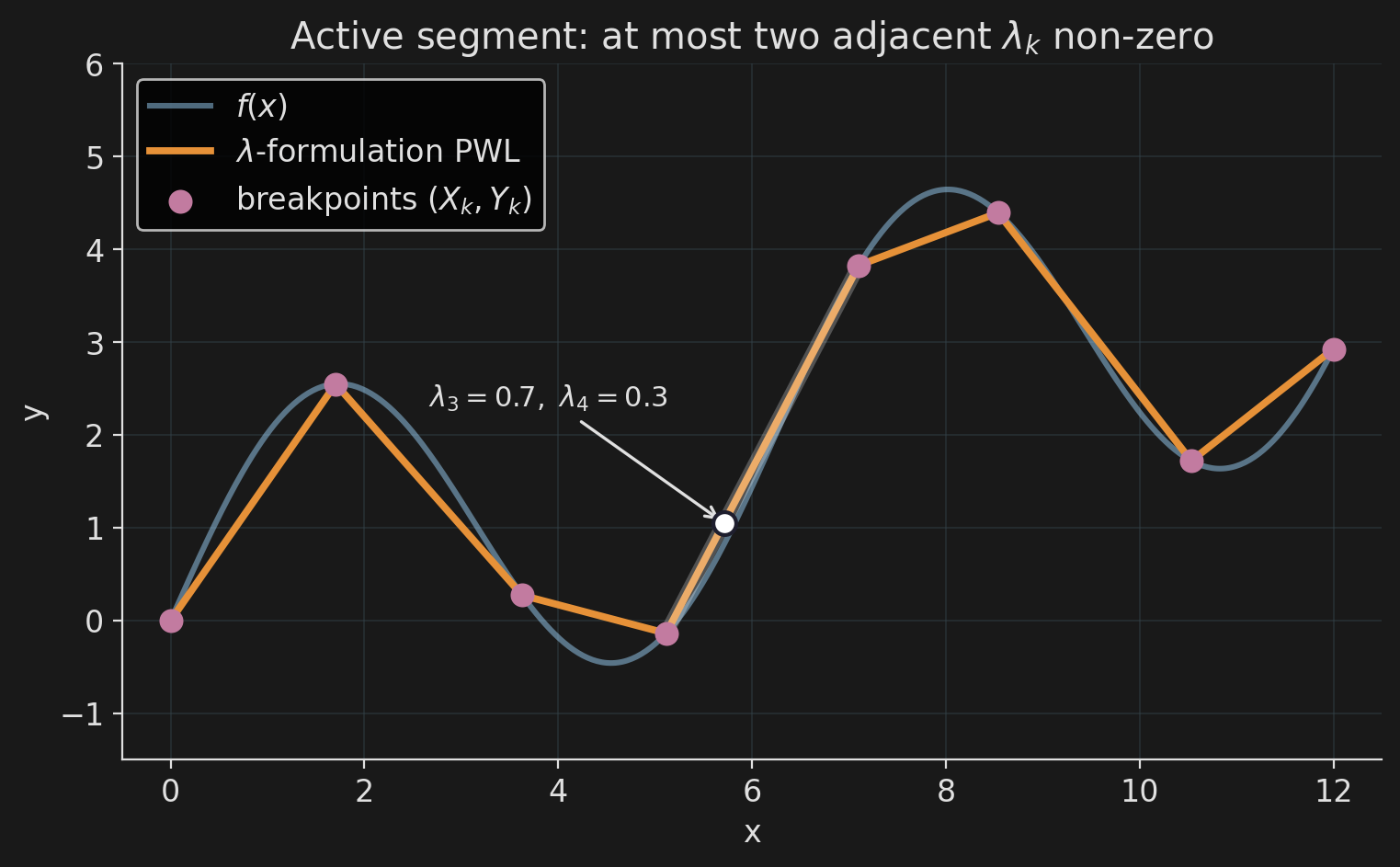
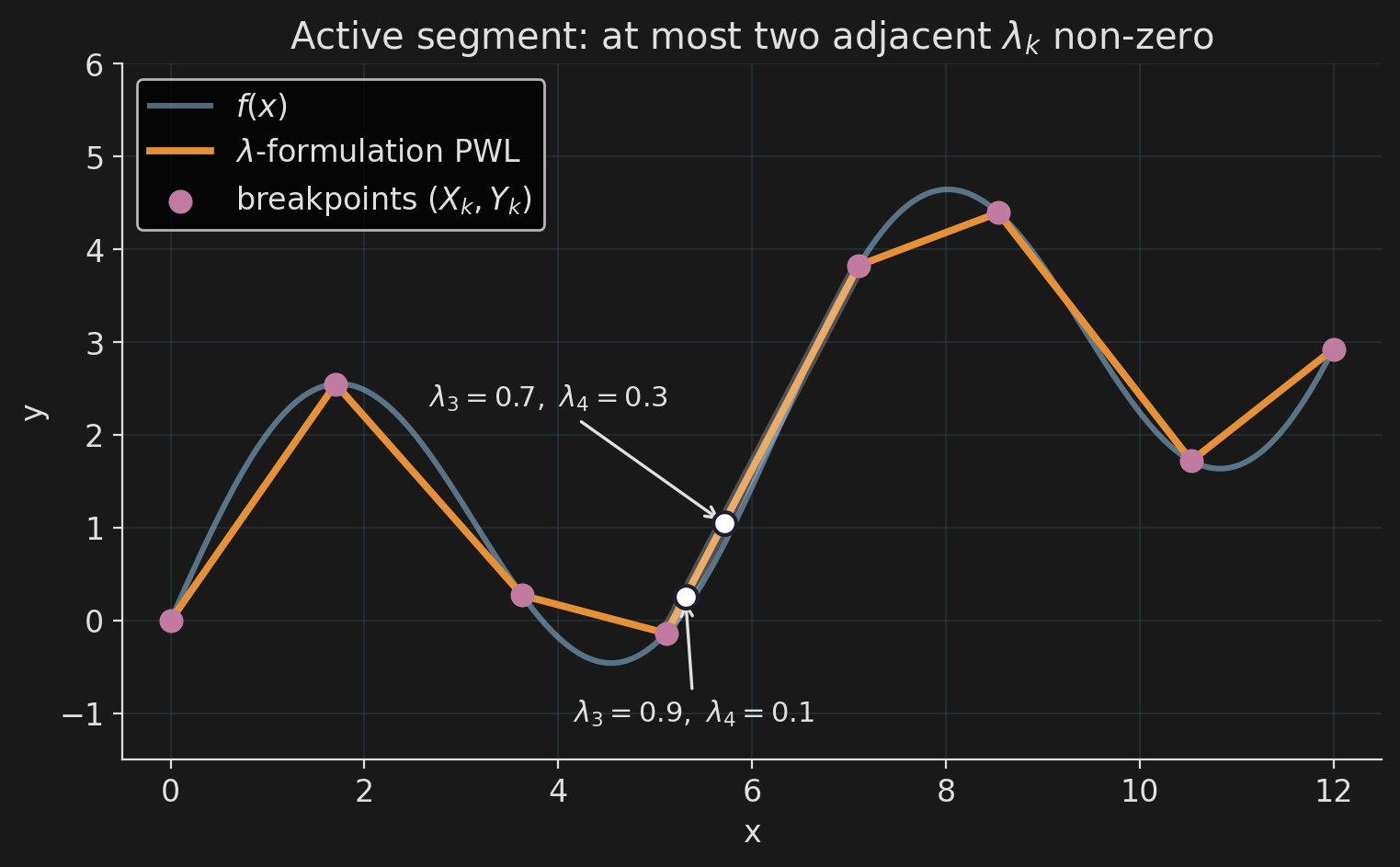
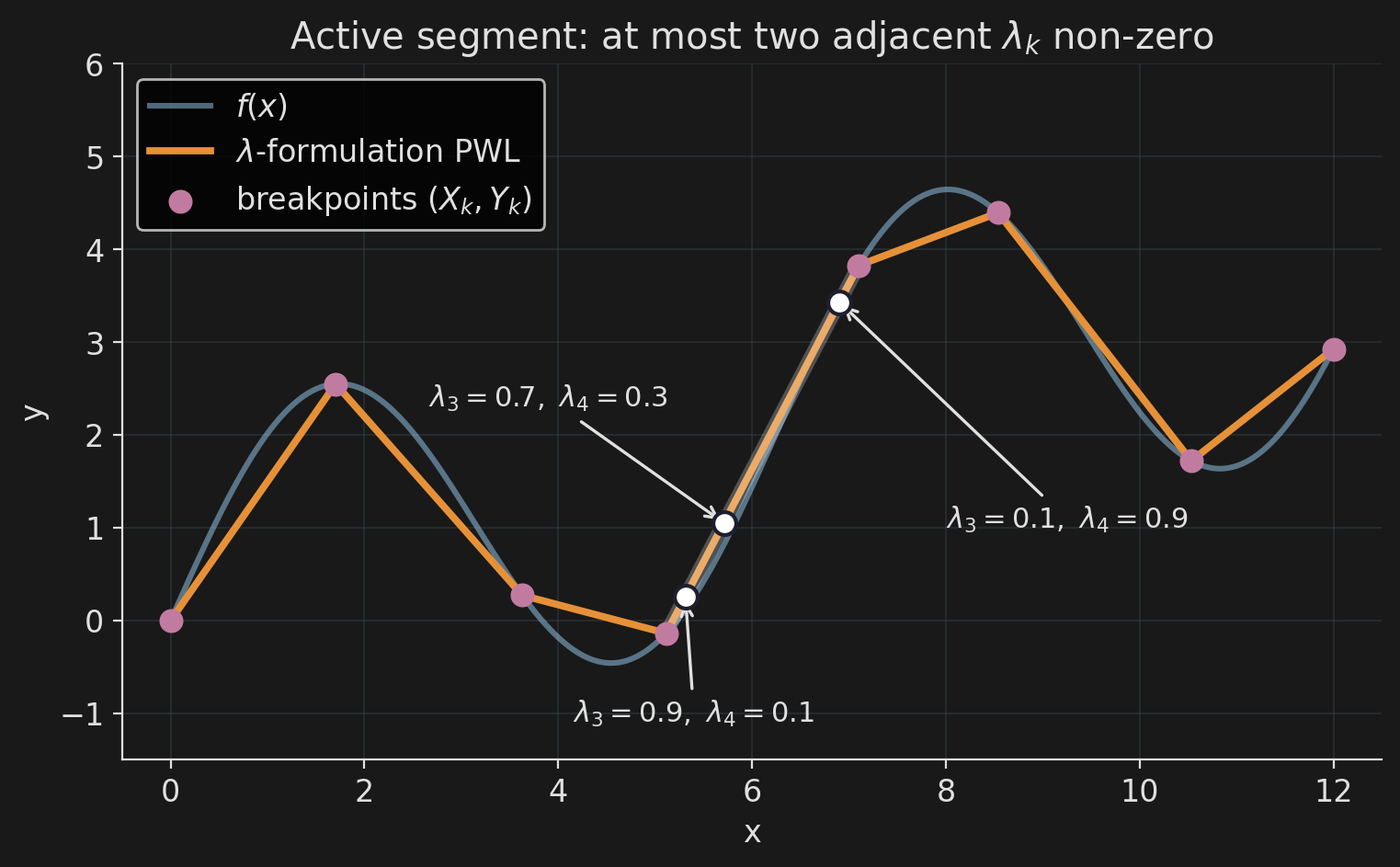
Breakpoints \((X_k, Y_k)\) are data. Each \(x\) is a convex combination of the \(X_k\); \(y\) uses the same weights:
\[ x = \sum_k \lambda_k\, X_k, \qquad y = \sum_k \lambda_k\, Y_k, \qquad \sum_k \lambda_k = 1, \;\; \lambda_k \ge 0. \]
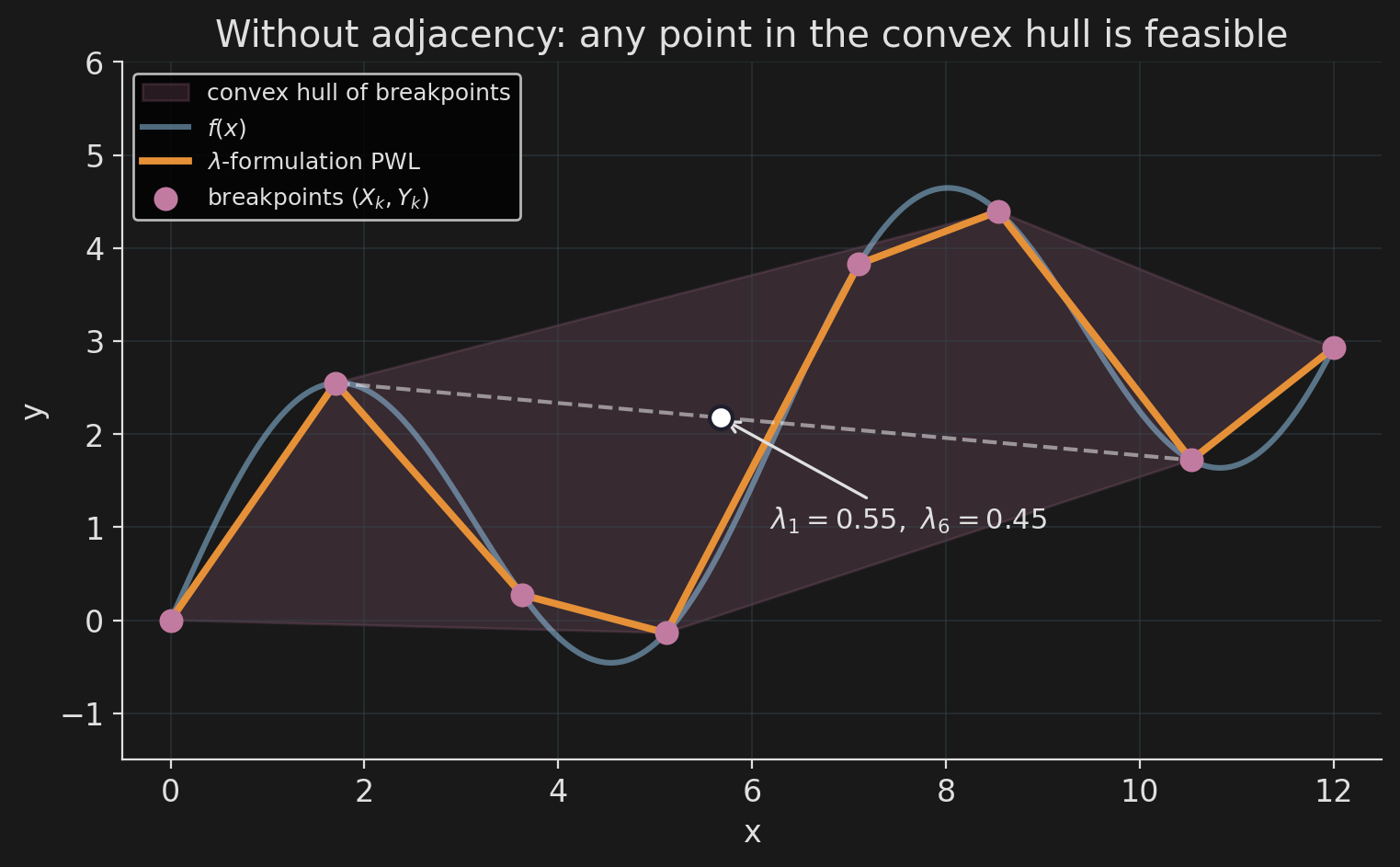
Adjacency. Only two consecutive \(\lambda_k\) may be non-zero. One activation binary \(b_k\) per segment:
\[ \lambda_0 \le b_0, \quad \lambda_K \le b_{K-1}, \]
\[ \lambda_k \le b_{k-1} + b_k, \quad \sum_k b_k = 1. \]

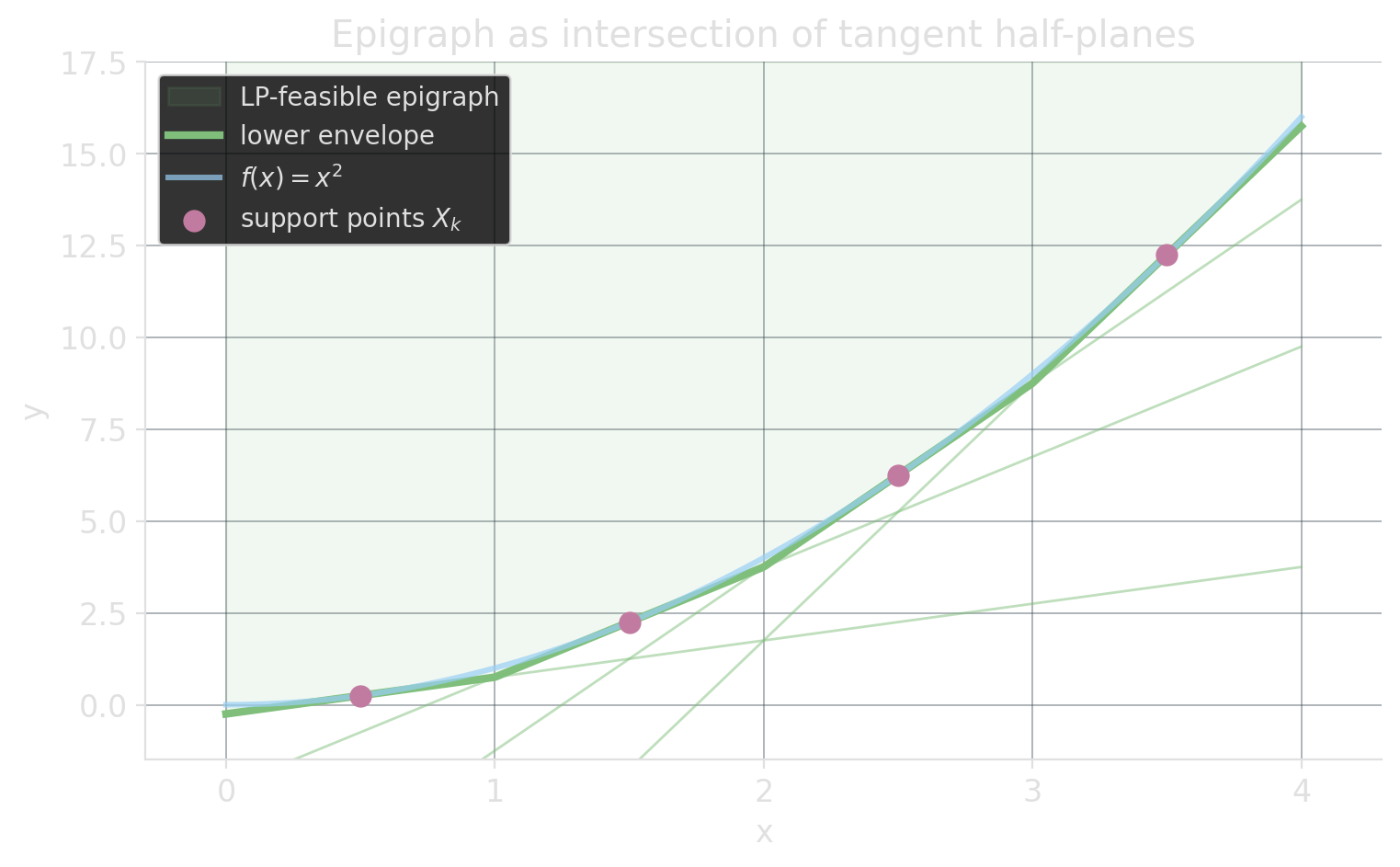
For convex \(f\), the epigraph \(\{(x, y) : y \ge f(x)\}\) is itself convex. Tangent half-planes from below give an LP-only encoding:
\[ y \;\ge\; f'(X_k)\, (x - X_k) + f(X_k) \qquad \text{for each chosen support } X_k. \]
The LP picks the binding tangent automatically: objective pressure pulls \(y\) down to the envelope. No binaries.
Only enforces \(y \ge f(x)\). Equality \(y = f(x)\) still needs segment-selection binaries.
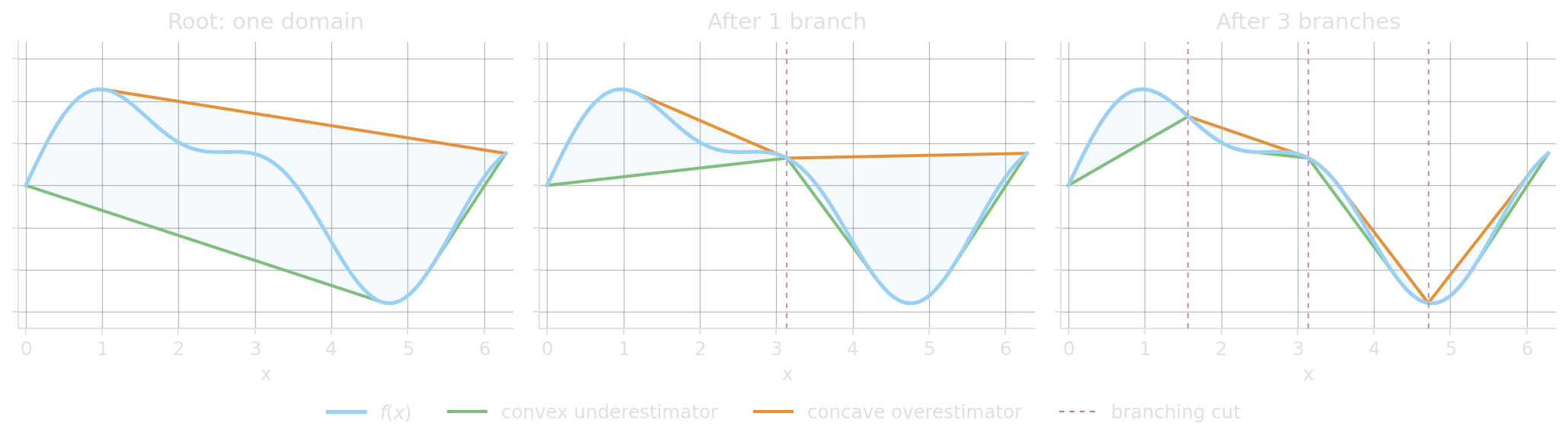
Some non-linear solvers approximate the function with convex/concave envelopes, branch on the variable’s domain, and refine the envelopes on every child node. Linear relaxations all the way down: an LP solver underneath, solving a non-linear problem.
Two correct models can present very different LPs to branch-and-bound.

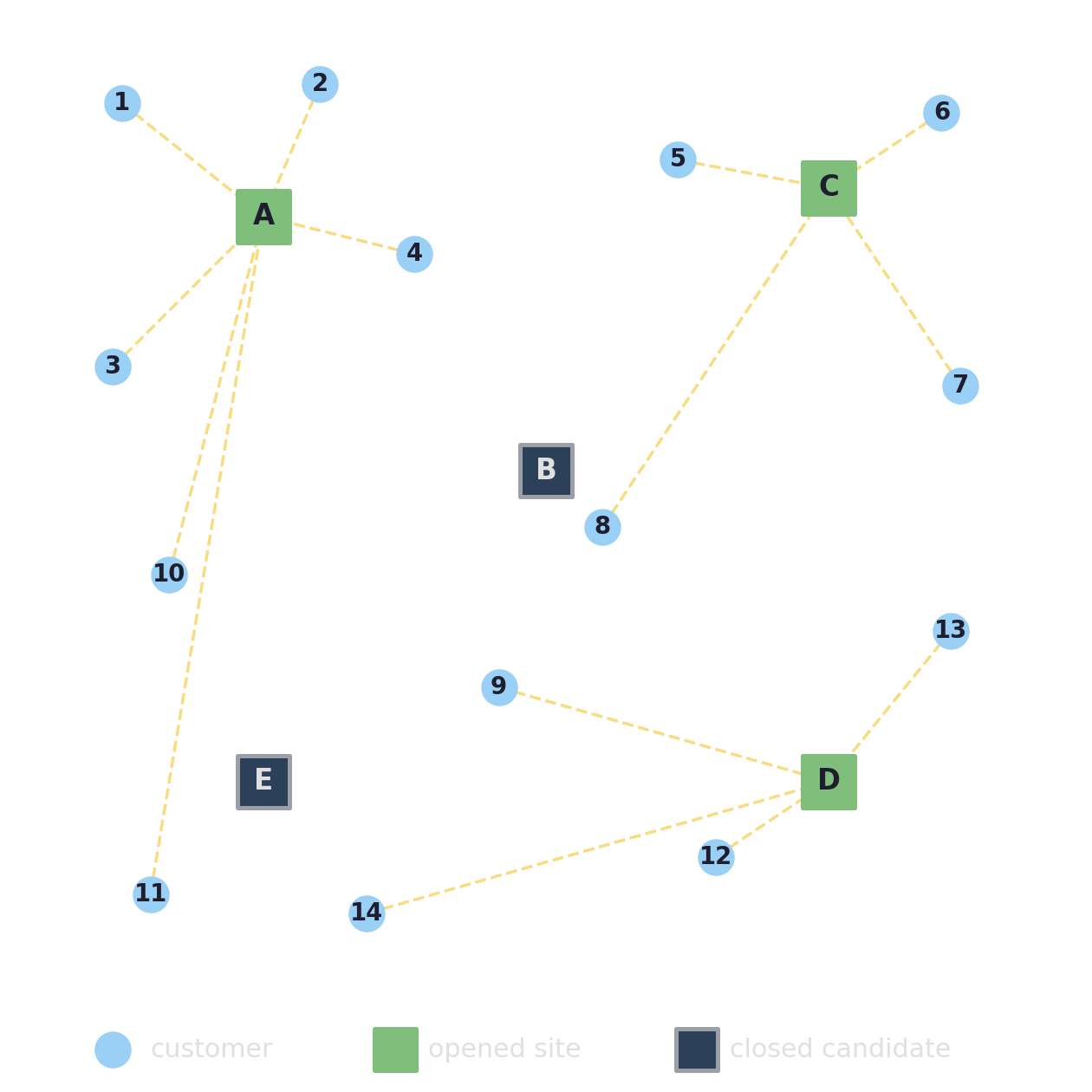
Customers need to be served from depots. Each candidate site \(j\) has a fixed opening cost \(f_j\); each pair carries a shipping cost \(c_{ij}\).
Pick which sites to open and how to assign every customer to an open site so that the total cost (opening plus shipping) is as small as possible.
Disaggregated.
\[ \begin{aligned} \min \;\; & \sum_j f_j\, y_j + \sum_{i,j} c_{ij}\, x_{ij} \\ \text{s.t.} \;\; & \textstyle\sum_j x_{ij} = 1 \quad \forall i \\ & \color{#e69138}{x_{ij} \le y_j \quad \forall i, j} \\ & x_{ij}, y_j \in \{0,1\} \end{aligned} \]
Aggregated (big-M).
\[ \begin{aligned} \min \;\; & \sum_j f_j\, y_j + \sum_{i,j} c_{ij}\, x_{ij} \\ \text{s.t.} \;\; & \textstyle\sum_j x_{ij} = 1 \quad \forall i \\ & \color{#e69138}{\textstyle\sum_i x_{ij} \le n\, y_j \quad \forall j} \\ & x_{ij}, y_j \in \{0,1\} \end{aligned} \]
\(n\cdot m\) small inequalities → tight LP relaxation.
\(m\) inequalities with big-\(M = n\) → weak LP relaxation.
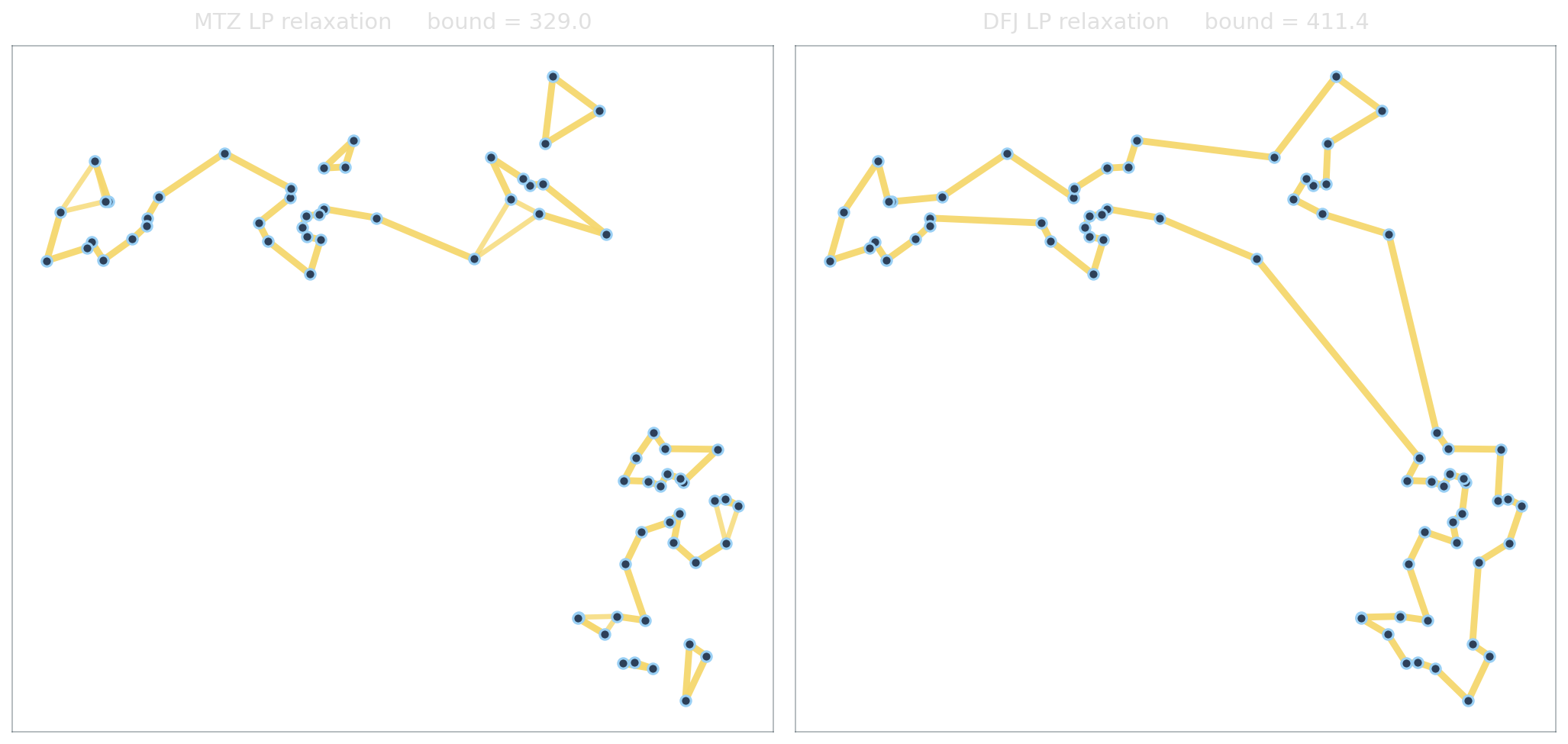
MTZ (directed).
\[ \begin{aligned} \min \;\; & \sum_{i \ne j} c_{ij}\, x_{ij} \\ \text{s.t.} \;\; & \textstyle\sum_{j \ne i} x_{ij} = 1 \quad \forall i \\ & \textstyle\sum_{i \ne j} x_{ij} = 1 \quad \forall j \\ & \color{#e69138}{\color{#3d85c6}{u_j} \;\ge\; \color{#3d85c6}{u_i} + 1 - n\,(1 - x_{ij})} \\ & \color{#e69138}{\qquad \forall i \ne j,\ i, j \ge 1} \\ & x_{ij} + x_{ji} \le 1 \quad \forall i < j \\ & x_{ij} \in \{0,1\},\ \color{#3d85c6}{u_0 = 0},\ \color{#3d85c6}{u_i \in [1, n{-}1]} \end{aligned} \]
DFJ (undirected).
\[ \begin{aligned} \min \;\; & \sum_{e \in E} c_e\, x_e \\ \text{s.t.} \;\; & \textstyle\sum_{e \in \delta(i)} x_e = 2 \quad \forall i \in V \\ & \color{#e69138}{\textstyle\sum_{e \in \delta(S)} x_e \ge 2} \\ & \color{#e69138}{\qquad \forall\, \emptyset \subsetneq S \subsetneq V} \\ & x_e \in \{0,1\} \end{aligned} \]
Big-M (\(n\)) → weak LP relaxation.
\(2^n - 2\) constraints → tight but unwritable.
Grötschel–Lovász–Schrijver (1981). An LP can be optimized in polynomial time iff its separation problem can be solved in polynomial time.
Separation: given \(\hat x\), return a violated constraint or certify there is none.
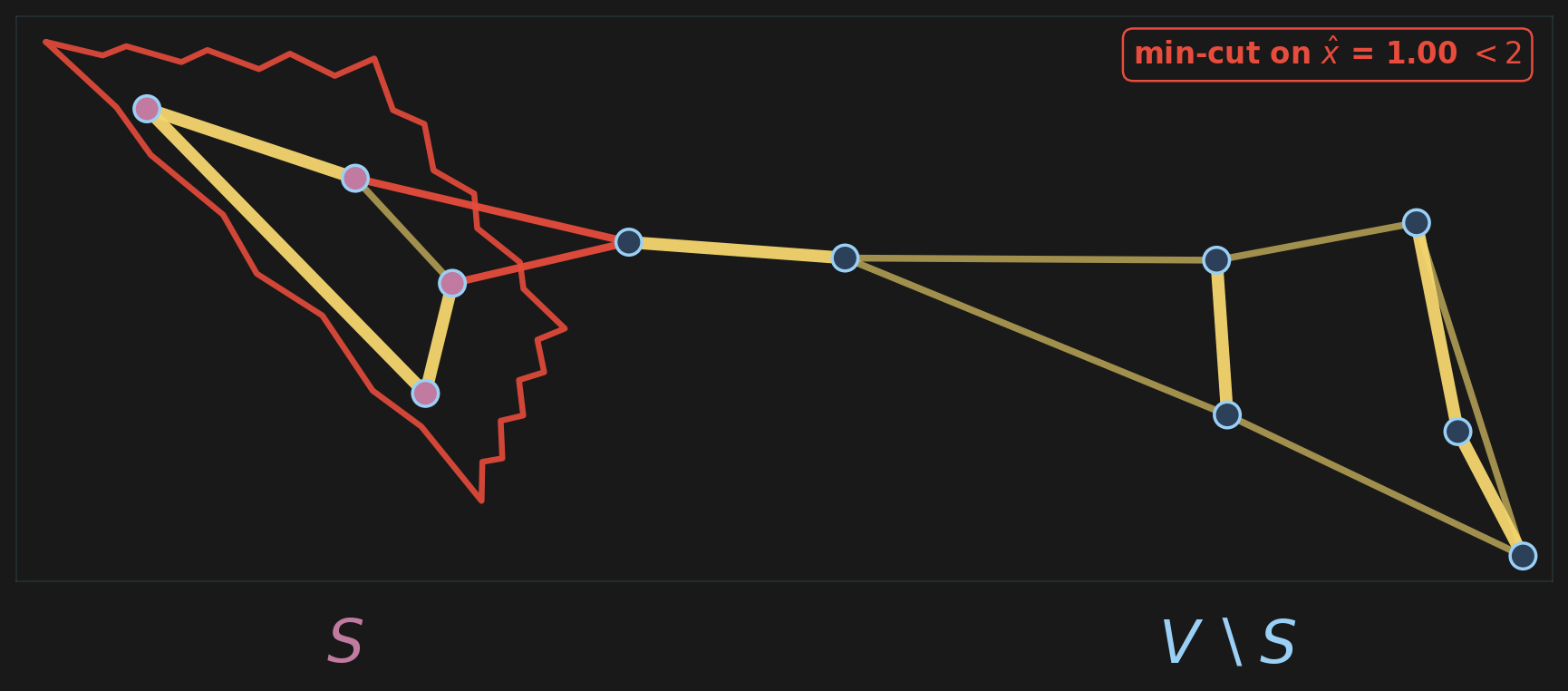
For DFJ, separation is min-cut on the graph weighted by \(\hat x\): cut value \(< 2\) yields a violated subtour inequality.
Confucypus says: under LP duality, variables are constraints and constraints are variables. The dual of separation is column generation.
The complexity of an LP is not defined by its naive size.
For some problem classes, every vertex of the LP polytope is integer. Simplex returns an integer optimum directly: no branching, no cuts. The “relaxation” is the algorithm.
Classical examples.
The usual sufficient condition is total unimodularity of \(A\) (Hoffman–Kruskal, 1956): then \(B^{-1}b\) is integer for any integer \(b\), so every basic solution is integer.
Brittle. A single fixed-charge, budget, or precedence constraint usually destroys integrality and pushes the model back onto the strong-vs-weak spectrum.
Algorithm Engineering SS 2026 — T03 LP/MIP Modeling